

NEWS
Identity, Belonging and Narrative
by Alexandra von Westernhagen
Since the 23 June 2016 referendum, in which the UK voted to leave the EU, Brexit has sparked intense debate, framed by visions of what would best serve Britain and its economy.
But the real discussion lay elsewhere than in economic arguments. What shaped the deliberation and ultimately the decision were questions such as:
Who am I? Where do I belong? How can I (re)gain control over my life? Do I see myself as part of a smaller, national framework or as part of something larger, European, even global?
Of course, economics played an enormous role in shaping voters’ views. But it was interpreted emotionally through the lenses of identity and fear rather than facts.
Identity and Belonging
Shortly after the referendum, my colleague David Harrison from our London-based EU law team sent me a draft letter for comment to be submitted to the European Commission on the UK’s withdrawal from the European Union.
In the letter, he argued that the EU could not simply “take away his EU citizenship.” I found the claim intriguing yet puzzling at first: what did he mean, and on what basis?
To recapitulate: on 23 June 2016, the UK government held a (non-binding) referendum in which it asked its electorate:
“Should the United Kingdom remain a member of the European Union or leave the European Union?”
The referendum result was that 51.9% of those who participated voted for the UK to leave the EU, while 48.1% voted to remain.
In the subsequent exit negotiations, the fate of UK citizens’ EU citizenship was treated as if it would automatically lapse upon the UK’s exit from the EU as a Member State.
That approach is legally much less straightforward than it might appear at first sight. Its implications are more significant than almost anyone involved in the negotiations acknowledged at the time.
The issue of mass removal of EU citizenship from over 60 million people deserves its own space, and it will get it.
For now, it suffices to note that the assumption that British citizens would simply cease to be EU citizens once the UK left the European Union was treated as self-evident, when it was anything but.
As I noted before, David’s first draft letter was somewhat unclear to me. Even though I am an EU lawyer with many years of experience working in Brussels, London, and various Member States, I had never really thought about what it means to be an EU citizen.
Did he intend to exercise his right of free movement and relocate to another European country?
Did he want to seek consular protection in a country where the UK lacked representation? Probably not.
Initially, I found David’s numerous arguments about “economic rights’ in his draft letter quite confusing, as I was completely unaware of the details.
But after reading what little had been written about EU citizenship and reflecting on the issue—often while looking at my purple passport as I crossed the Channel on the Eurostar—I began to understand where he was coming from.
As time passed, David Harrison was by no means the only one to take issue with the United Kingdom’s decision to leave the EU and what it would mean for its citizens and where they would belong after Brexit.
Love (and Hate) For the EU
Following the 23 June 2016 referendum, two camps formed among Britons, one of them being the so-called “Remainer” (or, from the other side’s perspective, “Remoaner”) camp.
As the date for the UK’s withdrawal was repeatedly postponed, their arguments seemed to shift away from what were presented as rational considerations, and towards more value-based, almost existential expressions.
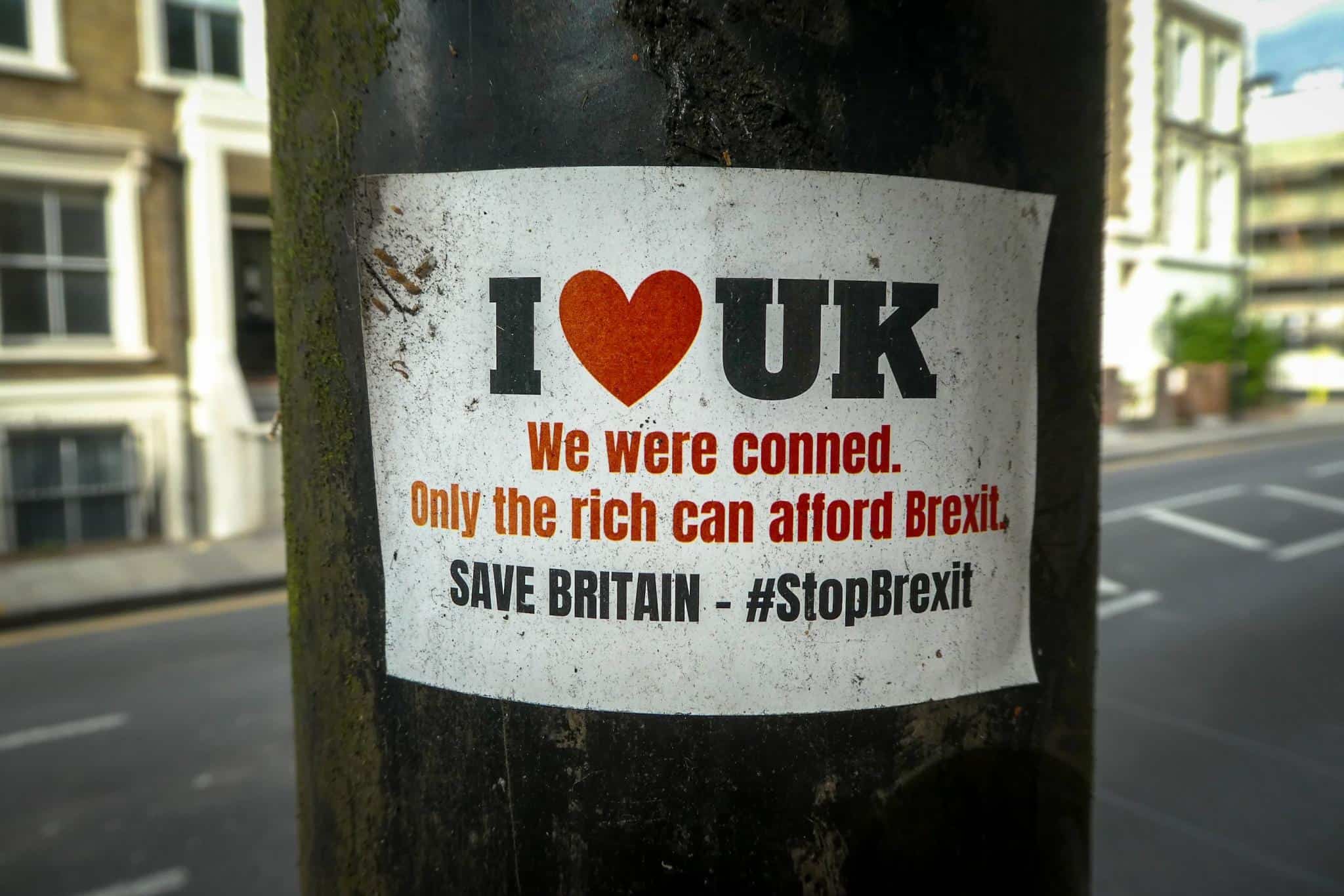
“I love the EU.”
“I am Scottish, British and European.”
These were messages I had never seen anywhere in the whole of Europe before, written on signs carried through demonstrations and marches across the country.
I found this movement quite surprising, for several reasons.
British culture, as I have experienced it, values restraint. It is no coincidence that both industrialism and the slogan “Keep Calm and Carry On” emerged here.
During a meeting at my previous law firm’s London office, I once shared that one of my happiest childhood memories was receiving a toy kitchen from my grandmother at Christmas.
My colleagues, all raised in England, looked at me with visible discomfort.
At the same time, the underlying legal and social structure in the UK differs significantly from countries such as Germany or France.
In legal terms, the British system (built on parliamentary sovereignty and common law) does not grant the individual the same constitutional standing as systems like Germany’s Basic Law (which was established much later, under the impact of World War II), where individual dignity and rights are foundational constraints on state power.
This matters significantly for context, as it suggests that for many British citizens, the EU’s language of individual rights and citizenship must be genuinely unfamiliar, if not foreign.
Against this background, I would not have expected such open expressions of attachment to the European Union by significant parts of the British population. The EU has never excelled at communicating the idea of a united Europe.
Paradoxically, Brexit triggered the largest spontaneous pro-EU campaign—a missed opportunity for the European project—while slogans like “Take Back Control” and “Make Our Own Laws” dominated the debate.
An Identity Crisis Triggered by Global Unrest and Demographics
What ignited this unexpected movement? (To recapitulate: the EU referendum commitment appeared on page 72 of the 2015 Conservative Party manifesto that ultimately prompted the 23 June referendum, in the second-to-last chapter, after economic policy, jobs, taxes, welfare, schools, hospitals, housing, energy, crime, counterterrorism, and pensions).
The answer is complex (because human nature is), but it certainly does not lie in objective economic assessments.
Henri Tajfel’s Social Identity Theory suggests that people define themselves through group belonging and instinctively distinguish between “us” and “them”.
“I am British”, “I am European”, and “I am not like them” are expressions of this subconscious mechanism: we favour our “own group” (here, I.E., the “pro-Europeans”) and feel threatened by the “other group” (here, I.E., the “Brexiters”).
Later work by Michael Hogg showed that uncertainty and instability strengthen these identity attachments.
This is exactly what happened before the 23 June 2016 referendum, when globalisation was an openly pursued policy direction, migration reached a new peak in Europe, and EU integration was perceived as blurring the lines between British nationality and “Europeanism”.
It is also no coincidence that support for leaving the European Union was not evenly distributed across British society. The data confirmed these divisions.
For example, YouGov’s reweighted post-referendum poll found that 64% of voters aged 65 and over voted Leave, compared with 29% of 18–24-year-olds.
Education was an even sharper divide: 70% of voters with GCSE-level education or below voted Leave, while 68% of graduates voted Remain. Men were slightly more likely than women to vote Leave, at 53% compared with 51%.
These are, on the surface, demographic observations.
But they also point to something less obvious yet nonetheless clear: the referendum did not reflect differing assessments of economic risk or opportunity, but rather differing experiences of stability, recognition, and change—and ultimately different understandings of one’s place in the world.
It is therefore no coincidence that younger voters, born into a globalised world and often with access to Europe through programmes such as Erasmus+, voted overwhelmingly to remain in the European Union.
By contrast, older voters—particularly those whose early lives were shaped by the Second World War—were more likely to be male and to support leaving the EU.
Their vote reflected less economic reasoning than a mix of national pride, identification with a still-aspirational United States, and, especially among less advantaged groups, a sense of regained political voice in a system that had not held a referendum since 1975 and that privileges collective over individual expression.
The appeal to “take back control” alongside contingencies such as poor weather on 23 June 2016 contributed to a narrow result that cannot be explained primarily in economic terms.
If that had truly been the case, what would such reasoning have been based on?
Before the referendum, the only serious study I am aware of was the HM Treasury analysis of April 2016, which projected that leaving the EU would cost UK households £4,300 per year.
No other serious study was undertaken by the British government into what it would mean for the country and its citizens, as individuals, if the UK were to leave the EU.
The Hidden Forces: Fear, Amplified by Power and Social Media
Research in political psychology shows that fear makes people prefer stability, clear boundaries, strong leadership, and familiar groups rather than openness, complexity, and long-term reasoning.
This is precisely what the Affective Intelligence Theory, co-developed by American political scientist George E. Marcus, confirms: emotions like anxiety and aversion, as well as enthusiasm, guide how citizens process information and respond to political events, rather than necessarily fact-checking.
In 2016, fear found fertile ground in the first wave of mass immigration to Europe due to war and climate change in the developing world, economies that had never recovered from the 2008 banking crisis, and other signs that the world as we used to know it (at least in Europe and for the past 70 years) was about to crumble.
Reform UK leader Nigel Farage was a prominent figure during Brexit and one of the leaders of the Leave campaign. Farage did not create the anxiety that drove the Leave vote. But he understood it, named it, falsified it, and amplified it.
His political agenda was (and remains) not so much about policy as constantly repeating the mantra that something had been taken (and more of it would be taken soon), that someone else was to blame, and that control could be reclaimed.
That this narrative was and is largely fictional in its details (remember, for example, the “enough is enough” slogan in front of an army of refugees while EU policy cannot impose the intake of non-EU immigrants?) did not diminish its emotional truth for those who felt it.
That Farage’s popularity is rising again is not a paradox of his failure to keep his promises.
The far-right populist’s supporters are not evaluating his track record. They are still voting for what he represents: the feeling of being seen and heard, of having a side, of belonging to a group, and the hope of regaining control over their lives.
For some of his voters, this also involves projecting responsibility for perceived problems onto shifting groups of “others”— LGBTQi, ethnic and religious minorities.
The Leave campaign’s narrative was amplified by social media, whose influence on public opinion and political behaviour was still poorly understood at the time.
Brexit was one of the earliest large-scale demonstrations of what can happen when political psychology, personal data and social media converge.
Together with other developments of that period, it ultimately contributed to regulatory initiatives such as the EU’s Digital Services Act (DSA).
Questions of cognitive influence, online behaviour and democratic resilience have since become legal questions as well, something that will be explored in a future article.
A Decade Later
Ten years on, Brexit is starting to look like a closed chapter—a peculiarly British episode.
The UK–EU reset, unfolding under geopolitical pressure, reinforces that impression: trade barriers are easing, cooperation is returning, and even Erasmus+ is back across the Channel.
But the story hasn’t ended. It has spread. The underlying dynamics were never resolved.
Identity anxiety, narrative capture, and fear as a political force are now visible across Western democracies: among the voters that returned Donald Trump to power, in the fragmentation of European party systems, and in the European Union’s struggle to explain what it is and why it matters.
We still behave as if political choices are rational. They are not. They are shaped by identity, belonging, and digital systems that amplify anxiety and insecurity.
Seen in that light, the UK–EU reset is both necessary and limited.
The relationship was never merely about trade or regulation. It was about shared values—freedom, democracy, the rule of law, and individual rights—and the belief that cooperation across borders yields outcomes neither side can achieve alone.
Those values did not disappear with Brexit. They lost their institutional voice.
Today’s reset is therefore more than a technical repair. It is a chance to recover a shared vocabulary, not just what we trade, but what we believe.
If European identity politics has a future, it will not be built on borders, flags, or bureaucracy, but on those founding values themselves.
This brings me back to David Harrison and his letter on EU citizenship.
What began as a legal argument turned into a journey from the General Court to the Court of Justice of the EU, and ultimately to Strasbourg, on behalf of some 60 million people whose EU citizenship was effectively assumed to have vanished overnight.
How that case unfolded—and what it revealed—is the subject of my next article.
In the meantime, David and I will raise a glass on 23 June 2026. Ten years on, and still going.
© Dr Alexandra Westernhagen. Photograph courtesy of Duncan Cumming. All rights reserved.
Originally published by The Battleground (22 June 2026)
https://thebattleground.eu/2026/06/22/the-real-story-behind-brexit/



If you are interested in becoming a member of the European Circuit, please complete our membership form using the link provided.
Join Us